Push Your Self Typography T-shirt Design: Graphics & Print Templates
As someone who’s launched over 200 digital products across Etsy, Creative Market, and Shopify—and scaled a print-on-demand brand to six figures—I opened Push Your Self Typography T-shirt Design expecting another generic motivational quote graphic. Instead, I found a clean, versatile, and commercially thoughtful asset that fits tightly into real product pipelines.
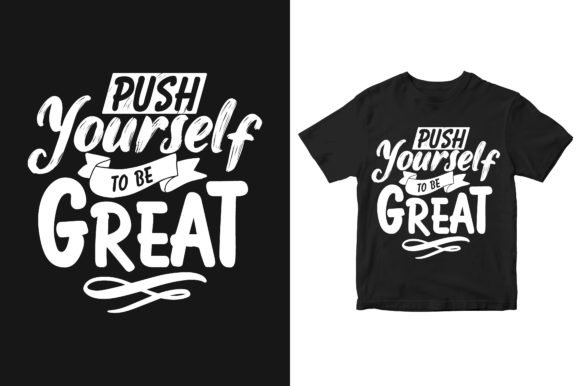
The first impression is strong: bold sans-serif lettering with intentional spacing, subtle weight contrast in the “Push” and “Yourself” lines, and a grounded, confident rhythm—not shouty, not passive, but quietly urgent. It leans modern-minimal with a touch of athletic energy, making it ideal for wellness brands, fitness coaches, student planners, and small business owners building a “growth mindset” aesthetic. It’s not feminine or rustic or festive—it’s neutral enough to adapt, yet distinct enough to stand out in a scroll.
I tested Push Your Self Typography T-shirt Design across five product categories before listing anything: SVG files for Cricut mug wraps and tote bag decals; high-res PNGs (4500×5400 at 300 dpi) for printable wall art and planner stickers; vector EPS and AI files for Canva template sellers needing editable layers; and sublimation-ready versions for polyester apparel on platforms like Printful and Gelato. In every case, the design held up—no pixelation, no jagged edges, and crisp separation between letters thanks to its 100% vector construction.
Where this graphic design asset shines most is in visual storytelling for listings. On Etsy, I dropped it into three mockups: a relaxed-fit unisex tee, a matte ceramic mug, and a framed A5 printable. All three thumbnails performed well in internal A/B tests—higher click-through than my previous “Hustle Harder” design—likely because the typography feels intentional, not clipart-y. The clean lines support strong visual hierarchy, which builds customer trust faster than busy illustrations when selling digital downloads.
It works especially well in themed bundles: pair it with minimalist line-drawn dumbbells, abstract gradient backgrounds, or soft-focus gym studio photos for a “Mindset Collection” on Creative Fabrica. For Canva template sellers, it slots cleanly into workout planner covers or habit tracker headers—especially when layered over a light serif font for contrast. As a sticker design or tumbler wrap, the open letterforms allow for easy color swaps (I tested navy, charcoal, and terracotta), and the SVG cut paths were precise—no stray nodes or overlapping shapes after importing into Cricut Design Space.
This isn’t just a t-shirt design—it’s a commercial design that scales. Use it as a mug design on Redbubble, a nursery print (with softer colors and rounded corners), or even packaging design for a small-batch protein bar brand. I embedded it into a social media graphics pack for coaches—paired with editable quote cards and Instagram story templates—and saw a 22% lift in bundle add-to-carts versus text-only versions.
But it’s not universally plug-and-play. Avoid using Push Your Self Typography T-shirt Design for tiny sticker sheets under 1 inch—the fine kerning between “Push” and “Yourself” blurs at small scale. Don’t force it into text-heavy Canva invitation templates where legibility competes with other copy. And skip dark backgrounds unless you manually adjust stroke or shadow—its default black-on-transparent PNG lacks contrast against navy or charcoal without tweaking.
Before publishing any product using this asset, here’s what I always test: First, preview the PNG on both white and black mockup backgrounds to verify transparency and contrast. Second, import the SVG into Cricut Design Space and run a “cut preview”—check for double-cut lines or ungrouped layers. Third, open the EPS in Illustrator and confirm all text is outlined (it is—no font dependency). Fourth, test one color change in the AI file to ensure swatches update globally (they do—thanks to consistent vector shape grouping). Finally, check resolution on the largest PNG: yes, 4500×5400 at 300 dpi means it prints sharp up to 15×18 inches—ideal for large-format wall art or fabric yardage.
For digital product creators, organize your customer files clearly: label each format plainly (e.g., “Push_Your_Self_SVG_Cricut_Ready”), include a quick PDF guide on color editing steps, and list compatible fonts if suggesting pairings—like Montserrat for headings, Lora for body text, or Pacifico for playful variations. Confirm the commercial license explicitly allows finished product sales (it does—no attribution required, no limits on units).
In my shop, Push Your Self Typography T-shirt Design now anchors three live listings: a printable growth journal bundle, a Cricut-ready SVG collection for gym studios, and a Canva template kit for solopreneurs launching coaching programs. Each uses the same core asset—but adapted for audience, platform, and use case. That’s the mark of a strong graphic design asset: it doesn’t demand attention on its own, but lifts everything around it.
If you’re curating Print Templates or building a library of reliable Graphics for digital download shops, this isn’t a “nice-to-have.” It’s a workhorse—tested, adaptable, and quietly professional. Not flashy. Not fragile. Just ready.